Sole designer2022–presentLyft
Designing AI tools for claim advocates, and an AI-native design handoff
Four years on Lyft's internal claims tooling. Part of the design problem now is the workflow itself: how AI changes what designers hand to engineers.
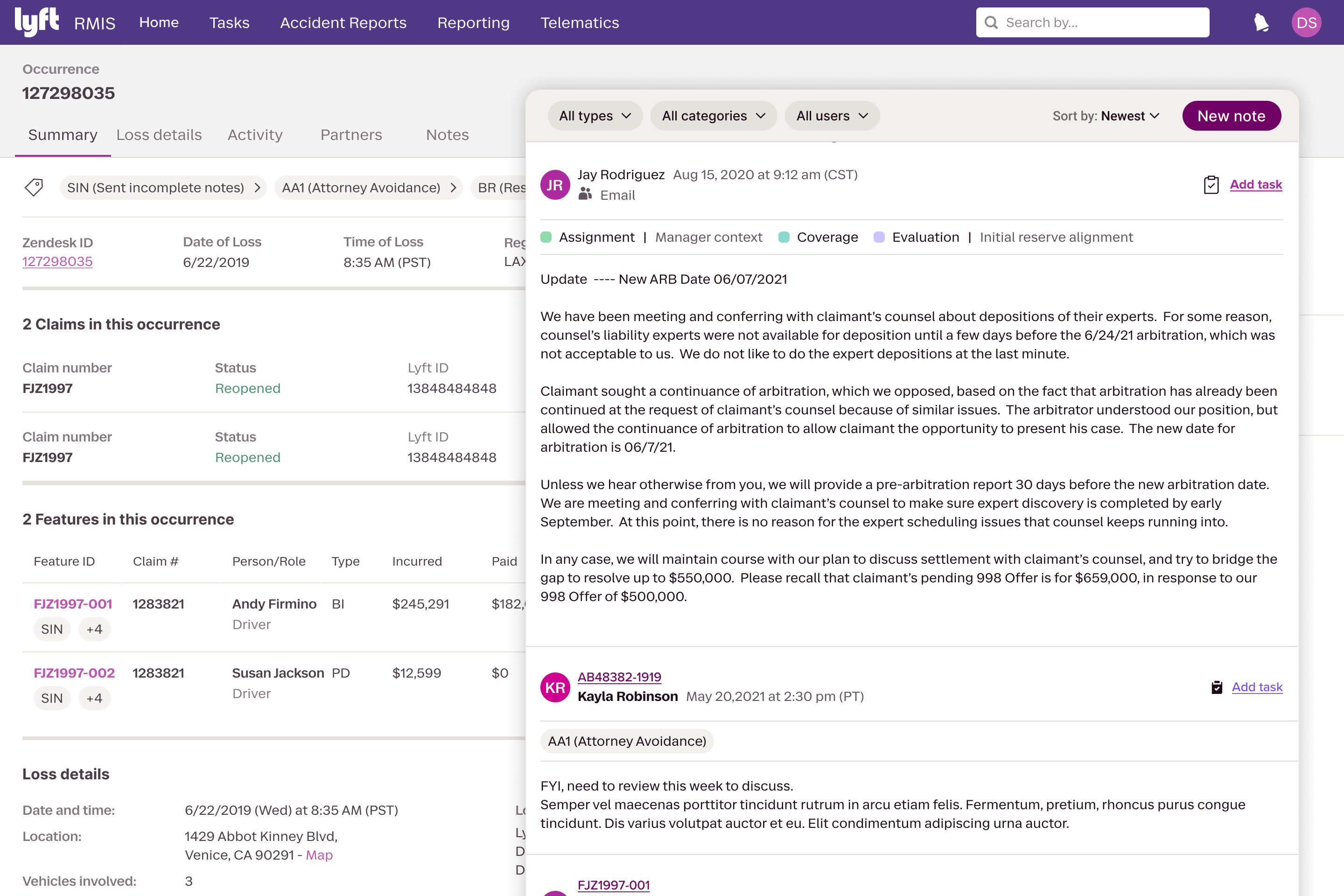
Summary
RMIS is Lyft's internally built risk management tool, six years old. AI changed how we're thinking about our users' work, and we've started integrating AI features such as 'Chat with a File' that have led to real workflow improvements within the tool. Then I started using AI in my own workflow too.
Since this is an internal tool, it was a great platform to test out using AI to tighten the design-to-code workflow. Figma is now the scaffold to describe designs to Claude, I prototype in Claude Code against a CLAUDE.md file that points at the real production components, and I share my code directly with engineering.
Work that used to take days now takes hours, and three engineers are building from my prototypes. At Lyft the prototype is still the deliverable. I don't commit to the production codebase here.
One password unlocks all three case studies. Email me for access.